
Introduction
India is preparing for one of the most significant tax reforms in decades. The New Income Tax Act 2025 aims to simplify the country’s taxation framework and modernize the way taxes are calculated and filed.
For many years, taxpayers have struggled with complicated provisions in the existing Income Tax Act of 1961. Over time, numerous amendments have made the law lengthy and difficult to understand. The new legislation seeks to solve this problem by creating a more organized and transparent system.
The reform focuses on simplifying tax rules, reducing litigation, improving digital tax administration, and making compliance easier for both individuals and businesses.
What Is the New Income Tax Act 2025?
The New Income Tax Act 2025 is a proposed legislative reform designed to replace or update the existing Income Tax Act introduced in 1961.
The primary objective is to create a simpler and more efficient tax system that aligns with modern economic and technological developments.
Key goals include:
- Simplifying tax laws
- Improving taxpayer services
- Reducing legal disputes
- Increasing transparency
- Promoting digital tax administration
The new law will help taxpayers understand their obligations more clearly and make compliance easier.
Why the Government Is Introducing a New Tax Law
There are several reasons behind the government’s decision to introduce a new income tax act.
Simplification of Complex Tax Laws
Over the years, the existing tax law has become extremely complex. Multiple amendments have made the act difficult for ordinary taxpayers to interpret.
Reducing Litigation
Tax disputes between taxpayers and authorities have increased due to complicated rules. Simplified laws can reduce these disputes.
Increasing Tax Compliance
A clear and simple tax system encourages more people to file taxes and follow regulations.
Supporting Digital Governance
India is rapidly moving toward digital governance. The new tax act supports this shift by promoting online tax filing and digital record keeping.
Key Features of the New Income Tax Act 2025
The new tax framework is expected to include several important features that improve the overall taxation system.
Simplified Structure
The new act will be written in simpler language and organized in a clearer structure so that taxpayers can easily find relevant information.
Introduction of the Tax Year
Instead of using separate terms like Previous Year and Assessment Year, the new system may introduce a single Tax Year concept.
This change will make tax filing timelines easier to understand.
Digital Tax Administration
Technology will play a major role in the new tax framework.
Expected improvements include:
- Fully online tax filing
- Automated processing
- Faster refunds
- Faceless assessments
Improved Compliance System
The new law aims to simplify documentation and reduce unnecessary paperwork.
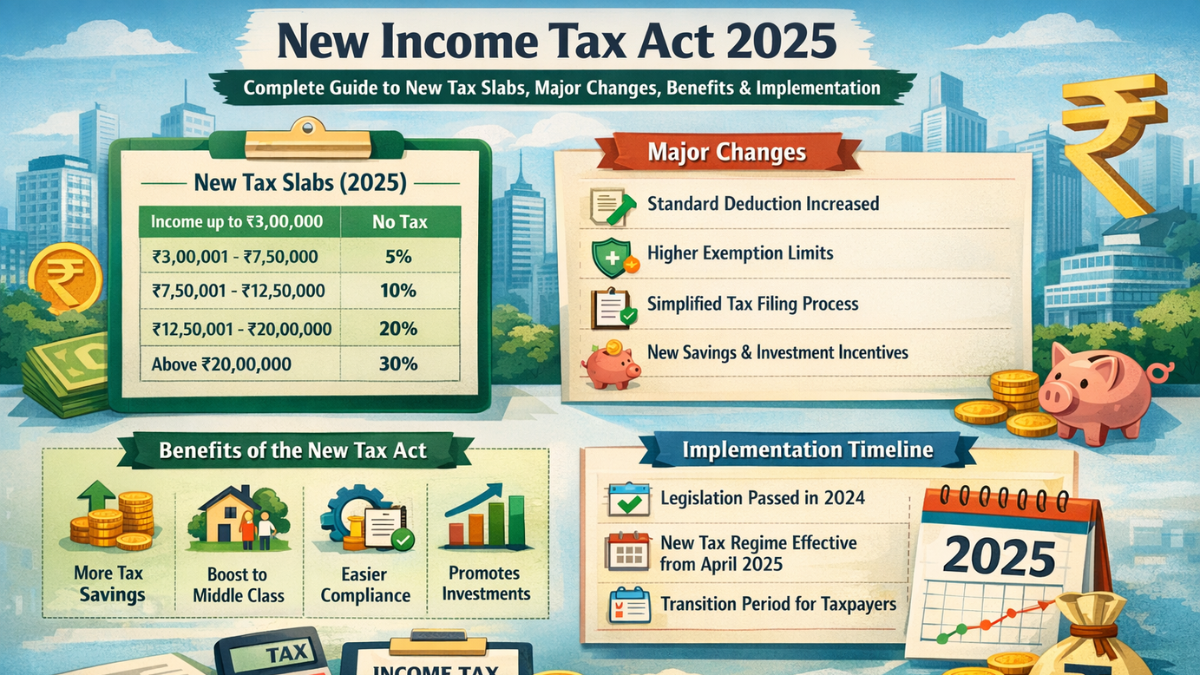
New Income Tax Slabs Under the 2025 Act
Although official rates may change, the government is expected to promote a simplified tax structure under the new regime.
Example tax slab structure:
| Income Range | Tax Rate |
| Up to ₹4 lakh | 0% |
| ₹4 – ₹8 lakh | 5% |
| ₹8 – ₹12 lakh | 10% |
| ₹12 – ₹16 lakh | 15% |
| ₹16 – ₹20 lakh | 20% |
| ₹20 – ₹24 lakh | 25% |
| Above ₹24 lakh | 30% |
This progressive system ensures that higher income groups contribute more while providing relief to lower-income taxpayers.
Major Changes in the New Income Tax Act 2025
The new legislation may introduce several significant reforms.
Removal of Outdated Provisions
Many provisions in the old act are no longer relevant. The new law will remove such outdated rules.
Simplified Capital Gains Taxation
Capital gains taxation may become easier to understand with clearer rules.
Enhanced Transparency
Digital tax administration ensures better transparency and accountability.
Faster Refund Processing
Automation will reduce delays in tax refunds.
Reduced Compliance Burden
Businesses and individuals may face fewer reporting requirements.
Benefits of the New Income Tax Act 2025
The new tax law offers several advantages for taxpayers and the economy.
Easier Tax Filing
Clearer rules make it easier for individuals to file tax returns without confusion.
Less Paperwork
Digital processes reduce manual documentation and paperwork.
Increased Transparency
Taxpayers can track filings, refunds, and notices online.
Improved Economic Efficiency
A simplified tax system encourages investment and business growth.
Impact on Different Taxpayer Groups
Different groups will experience the effects of the new tax act in different ways.
Salaried Individuals
Employees may find tax filing easier due to simplified tax slabs and fewer compliance requirements.
Small Businesses
Small business owners may benefit from simplified tax procedures and digital filing systems.
Large Corporations
Corporate tax compliance may become more efficient through better administrative systems.
Investors
Clearer capital gains rules may make investment taxation more predictable.
Income Tax Act 1961 vs New Income Tax Act 2025
| Feature | Income Tax Act 1961 | Income Tax Act 2025 |
| Complexity | Very complex | Simplified |
| Language | Legal and technical | Easy to understand |
| Filing system | Mixed manual & digital | Mostly digital |
| Tax year system | Previous + Assessment Year | Single Tax Year |
| Compliance | Lengthy | Streamlined |
Challenges of the New Tax Reform
Although the reform offers many benefits, some challenges may arise during the transition period.
Adjustment Period
Tax professionals and businesses may need time to adapt to new regulations.
System Updates
Accounting software and financial systems may need upgrades to align with the new law.
Awareness Among Taxpayers
The government may need to conduct awareness campaigns to educate taxpayers about the new system.
Implementation Timeline
The New Income Tax Act 2025 is expected to be implemented from April 2026, starting with the new financial year.
This transition period will give taxpayers and businesses enough time to prepare for the updated tax framework.
Future of Taxation in India
The new tax law represents an important step toward building a modern taxation system.
With simplified rules and digital administration, India aims to create a system that encourages voluntary compliance while supporting economic growth.
Conclusion
The New Income Tax Act 2025 marks a major milestone in India’s financial reforms. By simplifying complex provisions and embracing digital governance, the government aims to create a more efficient and transparent taxation system.
For taxpayers, understanding these changes will be crucial in the coming years. As the implementation date approaches, staying informed will help individuals and businesses adapt smoothly to the new tax framework.
FAQ
What is the New Income Tax Act 2025?
The New Income Tax Act 2025 is a proposed reform aimed at simplifying India’s tax system and replacing outdated provisions in the Income Tax Act of 1961.
When will the New Income Tax Act be implemented?
The new law is expected to come into effect from April 2026.
What are the key changes in the Income Tax Act 2025?
Major changes include simplified language, introduction of a tax year, digital tax administration, and streamlined tax rules.
Will tax slabs change under the new law?
Yes, the government may introduce revised tax slabs under the simplified tax regime.
How will the new tax law affect taxpayers?
The new system aims to make tax filing easier, reduce paperwork, and improve transparency.